





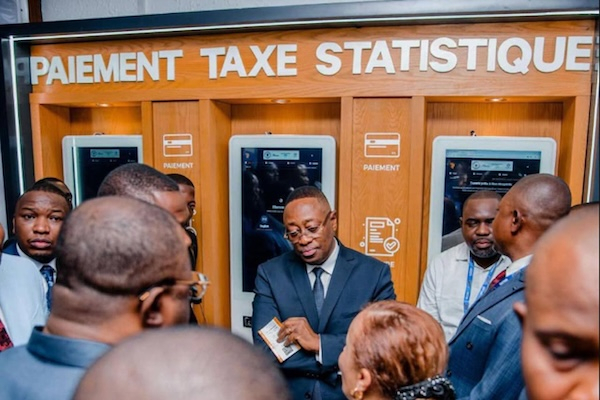
Kinshasa provincial Finance Minister Magloire Kabemba announced on June 11, 2026, that an electronic payment system for the statistical embarkation tax collected at N’djili International Airport will take effect in July.
The announcement came during a visit to the airport, where the provincial minister observed the installation of equipment intended for the implementation of the new collection system.
The statistical embarkation tax, commonly known as the “Kimbuta tax,” is the provincial share of the $5 fee paid by passengers departing from airports in Kinshasa. It is charged in addition to the passenger IDEF fee, better known as Go-Pass, an airport levy managed by the Airports Authority (RVA).
Under the announced arrangements, the amounts paid by travelers will remain unchanged. For domestic flights, the total fee will continue to be $15, including $10 for the RVA and $5 for the City of Kinshasa. For international flights, the total will remain $55, including $50 for the RVA and $5 for the province.
The main change concerns the payment method for the provincial share, which must now be paid electronically. Through the digitalization initiative, the City of Kinshasa aims to improve the traceability of funds generated by the tax and reduce weaknesses in the current collection system.
Revenue to Be Secured
These concerns are not new. In an article published in October 2019, DeskEco had already highlighted significant gaps between the expected revenue and the amounts actually collected from the statistical embarkation tax.
The outlet reported that the City of Kinshasa collected about $1.409 million between 2017 and June 2019. Based on estimated traffic of 420,000 passengers per year and a tax of $5 per passenger, potential revenue could have exceeded $2 million annually.
Provincial authorities at the time cited difficulties accessing bank statements and a lack of visibility into actual collection flows. The digitalization initiative announced this month is therefore aimed at addressing a longstanding issue involving the safeguarding of provincial revenue.
The initiative comes as the RVA is pursuing a separate project to digitalize the Go-Pass fee. That project aims to replace paper coupons with an electronic payment system designed to improve the traceability of revenue linked to the passenger IDEF fee.
In March 2026, the Public Procurement Regulatory Authority (ARMP) published a decision granting provisional contract award status to Mayele SAS for $4.06 million.
That process was suspended in early May 2026 by the ARMP’s Dispute Resolution Committee following an appeal filed by Veritas Engineering & Project Management Consultants against the RVA. The challenging company is seeking, among other things, a review of the documents that led to the provisional contract award. The ARMP ordered an audit before any final decision is made.
Contracts to Be Clarified
The system intended for the City of Kinshasa was reportedly developed by TRAFIGO SARL, according to several local media outlets. Available information does not specify the procedure that led to the selection of the company or the contractual terms governing its collaboration with provincial authorities.
TRAFIGO is a Congolese company established in 2016 and led by Magali Kayitesa Raway. The company highlights its expertise in securing and digitalizing payment operations.
It became known in particular through the deployment of an electronic payment system for border crossing fees at the Kasumbalesa border post on behalf of the Directorate General of Customs and Excise (DGDA).
According to several media reports relaying statements from the DGDA and TRAFIGO, the system helped improve revenue collection and supported financing for the modernization of the border post, which was inaugurated in October 2023 by President Félix-Antoine Tshisekedi Tshilombo. Those results would, however, benefit from confirmation through consolidated official data.
For Kinshasa, the digitalization of the provincial share of the embarkation tax therefore represents an important test. It could improve revenue monitoring, reduce areas of opacity and strengthen the province’s ability to mobilize its own resources.
But the effectiveness of the system will also depend on transparency surrounding the contract, monitoring of collected funds and the regular publication of revenue actually transferred to the provincial treasury.
Timothée Manoke