




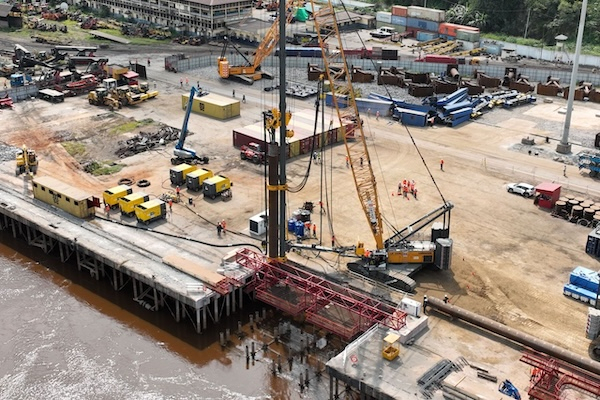
Eiffage Génie Civil Marine has officially launched the expansion project at the container terminal of the port of Matadi in the Democratic Republic of Congo (DRC), a year after securing the contract. On Jan. 26, 2026, the French company announced on social media that the first pile had been installed, marking the start of construction.
On Jan. 20, 2025, the Eiffage group said it had won a design-build contract worth more than 100 million euros to renovate and extend the Matadi port container terminal. The contract was awarded by Matadi Corridor Terminaux à Conteneurs (MCTC). The company has not commented on the one-year gap between the contract award and the start of construction.
The project is expected to take 27 months and includes several key elements of the terminal upgrade. It involves the construction of a new 350-meter-long and 30-meter-wide pile-supported quay, located in front of existing quays 5, 6, and 7. These structures will be connected by three 20-meter-wide access bridges. In addition to these port facilities, the project includes the construction of an operations building and a workshop building, as well as the rehabilitation of seven hectares of logistics platform to significantly increase the terminal’s capacity and improve traffic flow.
The work is part of Phase 2 of the container terminal extension program, launched in 2019 under an investment plan to double the terminal’s annual container throughput. According to initial objectives, the extension should increase processing capacity from 200,000 TEUs to around 400,000 TEUs (twenty-foot equivalent units), strengthening the port of Matadi’s ability to handle trade volumes for the country and its region.
A broader push
This expansion is taking place in a context where the port has historically suffered from outdated infrastructure and limited handling capacity. Improving the container terminal could reduce ship waiting times, optimize loading and unloading operations, and strengthen the country’s logistical competitiveness.
However, some analysts stress that the impact of this extension program will also depend on other infrastructure measures, such as dredging and buoyage along the Congo River channel, which determine access for large vessels to the port. Without these complementary improvements, deep-draft ships could continue to bypass Matadi in favor of neighboring ports with better maritime access.
At the local level, the project also raises hopes of knock-on economic effects, including direct and indirect job creation, stronger logistics services, and an improved position for the DRC in regional supply chains.
The Matadi container terminal extension is part of a wider push to modernize Congolese port infrastructure. Alongside this expansion, the effort includes renovation work on existing quays, projects for adjacent logistics zones, and initiatives to strengthen the efficiency of national port operators.
Pierre Mukoko