




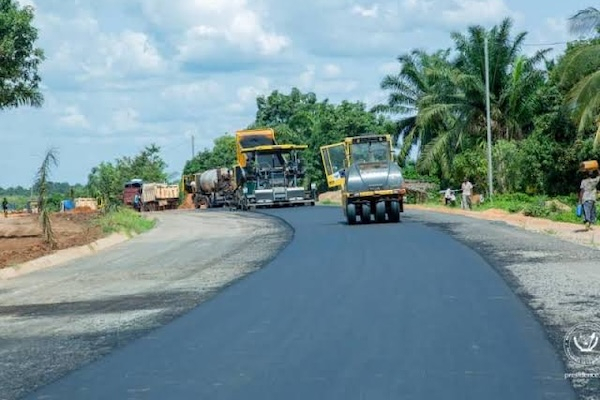
The 230-kilometre Kananga-Kalambambuji road is now open to traffic, and crews are laying the final asphalt surface, the presidency said during President Félix-Antoine Tshisekedi’s visit to Kananga. The strategic route, linking Kasaï-Central to Angola’s Lobito corridor, is seen as key to ending the province’s isolation and boosting cross-border trade.
The presidency said construction has stepped up, with work entering an “active phase”. A 600-metre test section was completed at the end of December 2025 at PK5 to test the quality of the bitumen before paving continues along the full length of the road.
The director general of the Congolese Agency for Large Works (ACGT) said on July 4, 2024, that the 230-kilometre project would cost $300 million and is due to take up to three years. He added that $40 million was already available under the revised Sino-Congolese funding agreement signed on March 14, 2024.
The project also includes four bridges over the Miao, Lueta, Kabelekese and Kasaï rivers to keep traffic moving along the entire route.
In July 2025, a site inspection led by ACGT deputy director general Jean-Claude Mido and presidential infrastructure adviser Martin Kabuya confirmed that vehicles could reach the Angolan border. They said on July 11 that the trip between Kananga and Kalambambuji could then be completed in six to seven hours.
Further improvements were planned as full construction progressed, particularly on the Matamba-Tshinyama section, where crews were building drainage channels and reinforcing the base layer using locally produced crushed stone from Shamatengu.
According to the presidency, the Kananga-Kalambambuji road is part of a broader strategy to develop multimodal rail and road links between the centre of the country and the port of Lobito. Beyond its logistical role, the route is expected to connect Kasaï-Central to international markets, facilitate cross-border trade and open up rural communities that were previously cut off.
Boaz Kabeya