




The Democratic Republic of Congo has stepped up efforts to expand local participation in the transport of export goods.
In a decision signed on April 17, 2026, the director general of the Private Sector Subcontracting Regulatory Authority (ARSP), Miguel Katemb Kashal, gave foreign transporters 60 days to comply with a requirement to cede at least 50% of their market share to Congolese operators.
"Failing that, client companies are required to immediately terminate contracts with non-compliant transporters," the decision states. It specifically targets the mining sector, which accounts for a significant share of transport activity. After the deadline, any company — mining firms in particular — that continues to work with a non-compliant transporter will face sanctions under the Feb. 8, 2017 subcontracting law, the decision adds. Those sanctions can include a ban on operations.
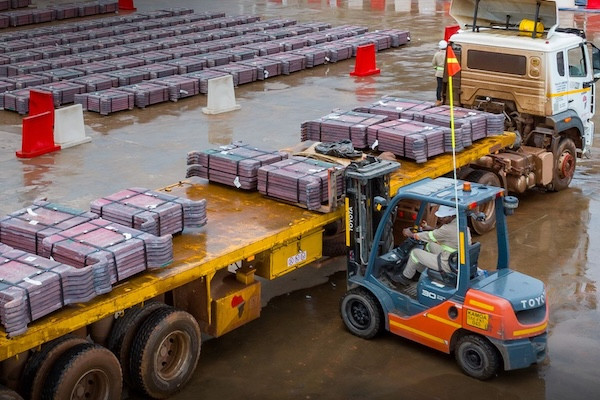
The 50-50 principle was introduced by a ministerial decree in December 2024 but has yet to be enforced. With this decision, the ARSP is intensifying pressure on mining operators to comply. The stated objective is to rebalance a market dominated by foreign operators, particularly on the mining corridors linking Greater Katanga to regional ports, and retain a greater share of the value generated by the mining sector. Congo exports more than three million tons of copper per year.
On the ground, industry players are warning about the limits of such a rapid rollout. "In 2024, trucks registered in the DRC accounted for less than 5% of import-export transport flows," said a member of the Mining Chamber of the Federation of Congo Enterprises (FEC). "Going from 5% to 50% in 60 days is not realistic, even if the goal remains worthwhile and should ultimately be achieved," the person added. Local transporters also face insurance and compliance constraints that limit their access to international contracts.
Structural constraints
"Foreign transporters dominate the market because they are more competitive," the source said, before raising a pointed question: "Are the Congolese companies being asked to reclaim this market share in 60 days ready to offer their services under the same conditions?"
Regional obstacles compound domestic difficulties. "To enter Zambia, for example, drivers must obtain a visa in advance, limited to 180 days. With turnaround trips, that quota runs out quickly, while drivers from other countries often benefit from visas on arrival," the source said.
The logistical demands of the mining sector present another challenge. "Multiplying transporters for the same cargo increases risks. Quality differences on arrival can lead to a lower price for the product," another industry player said.
Caught between efforts to assert economic sovereignty and operational constraints, the transition to a 50-50 split is likely to be a long-term structural undertaking, whose outcome will depend as much on business climate reforms as on regulatory capacity. Several Congolese entrepreneurs prefer to register their companies in Zambia, Tanzania or South Africa, where business conditions are more favorable, according to multiple accounts.
Pierre Mukoko