




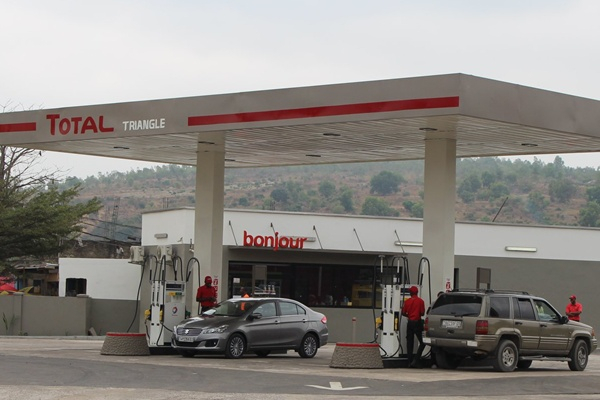
New petroleum product prices took effect in the Democratic Republic of Congo (DRC) on April 17, 2026, raising pump prices and further increasing costs for the mining sector, which has been excluded from fuel subsidies since mid-2025.
Under the new pricing, gasoline in the West Zone—used as a benchmark—rose to 2,640 Congolese francs (FC) per liter from 2,440 FC, while diesel increased to 2,635 FC from 2,430 FC, marking rises of 8.2% and 8.4%, respectively. In the North Zone, prices stand at 3,350 FC for gasoline and 3,345 FC for diesel.
In the South Zone, gasoline and diesel are priced at 3,930 FC and 4,465 FC per liter, respectively. In the east, where logistical constraints are greater, prices have reached 4,400 FC for gasoline and 5,600 FC for diesel.
In the mining sector in the South Zone, gasoline and diesel prices rose by 22.6% and 28.4%, to $2.55 and $3.12 per liter, respectively, from $2.08 and $2.43. This follows increases of 30% for gasoline and 43% for diesel in mid-March, bringing cumulative rises over one month to 59.4% and 83.5%.
In the East Zone, mining-sector prices climbed to $2.06 for gasoline and $3.10 for diesel, up from $1.60 and $1.65 in July 2025, representing increases of 28.7% and 88%.
Supply security
According to a statement from the Ministry of National Economy, the revision was approved after a meeting of the Petroleum Products Price Monitoring Committee (CSPPP) held from April 15 to 16. It aims to balance household purchasing power with adjustments to international market conditions.
The move comes amid tight global oil market conditions. Since the start of the Middle East conflict, Brent crude has hovered around $100 per barrel, compared with a previous range of $60 to $70.
To secure domestic supply, the government plans to introduce an advance payment mechanism for distributors, with support from sectoral ministries. The CSPPP also approved early payments for losses and shortfalls ahead of the quarterly certification process to ease operators’ cash flow constraints.
Separately, authorities are exploring alternative supply routes. Economy Minister Daniel Mukoko Samba is considering sourcing from Nigeria’s Dangote refinery to diversify imports and ease pressure on the logistics chain.
Ronsard Luabeya