




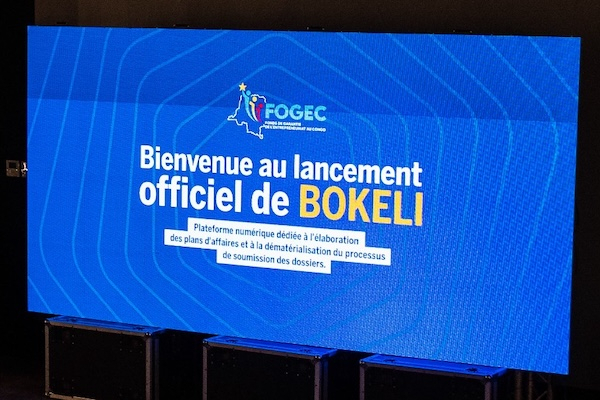
The Fonds de Garantie de l’Entrepreneuriat au Congo (FOGEC), a state-backed guarantee fund, on Tuesday launched a digital platform in Kinshasa aimed at helping entrepreneurs develop business plans and streamline the financing application process.
The platform, called Bokeli, forms part of government efforts to strengthen support for entrepreneurs and improve access to credit for small and medium-sized enterprises (SMEs), startups and artisans.
Accessible at bokeli.fogec.cd, the platform enables entrepreneurs to structure their projects using digital tools for business plan development, financial documentation and submission to relevant institutions. The aim is to produce clearer, bank-ready applications that meet financial institutions’ requirements, while reducing administrative hurdles in financing procedures.
The initiative addresses a recurring challenge in Congo’s entrepreneurial ecosystem: the poor technical quality of many loan applications submitted to banks and guarantee schemes. FOGEC’s mandate is to facilitate access to financing for viable SME, startup and artisan projects by providing guarantees, in an environment where bank collateral requirements remain a major constraint.
The launch comes as entrepreneurship continues to expand, driven in part by a young population increasingly engaged in business creation. However, this momentum has yet to translate into structured financing. According to Partech Africa, funding raised by Congolese startups remains limited relative to the country’s market potential, highlighting persistent barriers to capital access for early-stage companies.
Since its creation five years ago, FOGEC has supported nearly 300 projects worth a total of about $3.2 million. Against this backdrop, challenges related to project formalisation, business plan quality and procedural complexity remain central. By offering a digital tool focused on these steps, FOGEC aims to improve project bankability and facilitate exchanges between entrepreneurs, guarantee bodies and financial institutions, in order to better support the development of the domestic productive sector.
Samira Njoya