




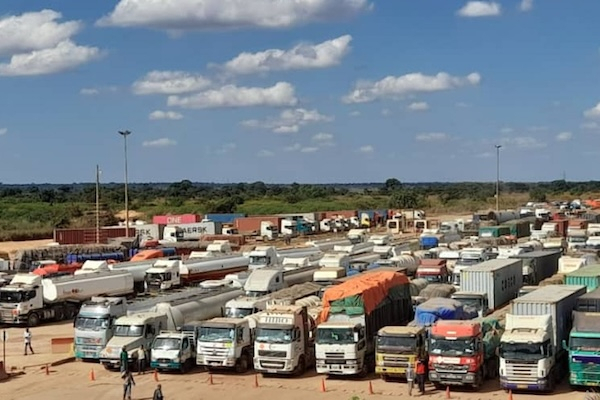
New compliance procedures at Kanyaka, on the Lubumbashi-Kasumbalesa road, are disrupting freight traffic between the Democratic Republic of Congo and Zambia. On May 28, the Zambia Revenue Authority (ZRA) said it was in talks with the DRC's Directorate General of Customs and Excise and other stakeholders to restore normal traffic on the strategic corridor.
In an official statement, the ZRA said congestion at Kasumbalesa stemmed from the introduction of additional compliance and inspection procedures at Kanyaka. Late last year, a scanner checkpoint was established at the DRC border post, requiring vehicles carrying goods to pay a fee of $100. The measures have affected freight flows and the processing of customs transit guarantees, the authority said.
The disruptions at Kasumbalesa have also affected other border crossings handling transit cargo, including Kazungula and Chirundu, the ZRA said. The authority added that it was working with Congolese authorities and other stakeholders to restore traffic flow.
Contested checkpoint
In mid-May, local media had already reported gridlock on the road to Kasumbalesa, the main economic corridor linking Haut-Katanga province to Zambia. Hundreds of trucks were reportedly stranded following the introduction of the paid scanner inspection at the Kanyaka post.
The situation echoed tensions on the same route in December 2025, when truckers protested the new scanner fee, triggering major traffic jams and disrupting freight movement between Lubumbashi and the Zambian border.
The checkpoint stems from a communiqué signed by Haut-Katanga's interim governor, Martin Kazembe Shula, announcing the installation of a scanner post at Kanyaka under an interministerial decree dated December 5, 2012, on the creation and implementation of the Timber Production and Trade Control Program and other substances. Under the communiqué, all vehicles carrying goods of any kind, including tankers transporting petroleum products, acids and gas, were required to undergo a non-intrusive export inspection and pay the applicable fees.
Faced with protests from transporters in December 2025, Kazembe traveled to the site to try to defuse the crisis. According to local media reports and journalists on the ground at the time, the interim governor announced a moratorium to allow authorities to explain the measure to affected operators.
Strategic corridor
The dispute resurfaced in May 2026 as tensions over Kanyaka flared again. On May 17, the interim governor visited the toll station once more, accompanied by members of the provincial security committee, representatives of the Federation of Congo Enterprises, road hauliers and several public agencies involved in managing the corridor.
According to a statement from the Haut-Katanga governorate, provincial authorities maintained that the scanner was not responsible for congestion on the Kasumbalesa road, attributing the bottlenecks instead to broken-down vehicles, accidents, reckless driving and slow administrative procedures. The governorate said it nonetheless intended to improve traffic flow while maintaining the inspection system.
The situation is being closely monitored by the business community. The Kasumbalesa road is one of the main supply routes for the Katanga mining region and a key corridor for trade between the DRC and southern Africa. Any prolonged disruption to traffic could affect supply chains, mining operations, cross-border trade and the revenues generated by those flows.
Timothée Manoke