




The Mbanza-Ngungu Agro-Industrial Park project, which aims to produce 650,000 metric tons of food annually, is entering a critical phase of development. After several months of consultations with development partners, the Ministry of Agriculture and Food Security is seeking to secure funding for feasibility studies estimated at more than $15 million.
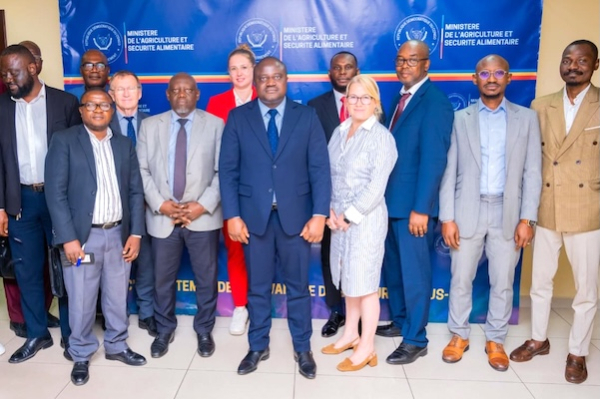
To that end, a roundtable meeting was held on June 11, 2026, at the ministry's offices in Kinshasa. According to sources who participated in the discussions, the meeting helped establish the framework for an operational timetable.
The objective is to finalize the financing structure for the studies before September, complete the selection of service providers before October and launch the feasibility studies no later than October.
"Since the beginning of the year, the minister had approached several institutional donors to finance the agro-industrial park project, starting with the feasibility studies," one of the sources said.
Among the partners approached were the World Bank, the African Development Bank (AfDB), the International Fund for Agricultural Development (IFAD), the French Development Agency (AFD), the Japan International Cooperation Agency (JICA) and Germany's public development bank KfW.
Donors Mobilized
Discussions launched in February 2026 have revealed strong interest from donors in the project, but also a demand for greater clarity. The institutions approached requested additional details on the terms of reference, the overall budget for the studies, the expected contribution of each institution and the arrangements for coordinating the process.
One of the main outcomes of the June 11 meeting was the designation of the United Nations Industrial Development Organization (UNIDO) as the lead coordinating agency and the World Bank as lead donor.
Their role would be to ensure technical and institutional consistency across the various study components and donor interventions, helping to avoid fragmented support and duplication of efforts.
The feasibility study budget is now known. It is structured around several components. Industrial engineering accounts for the largest allocation at $5.1 million, representing 32.3% of the total. Studies related to buildings and urban planning are estimated at $4 million, followed by infrastructure and energy studies at $2.05 million.
Technical field and agricultural studies, environmental and social assessments, and pre-project coordination account for the remainder of the budget.
Funding Prospects
This breakdown confirms the integrated nature of the project. Led by Swiss commodities trading group Mole, which specializes in agricultural raw materials, the Mbanza-Ngungu Agro-Industrial Park extends well beyond a conventional agricultural initiative. It also requires infrastructure, industrial equipment, energy solutions, land development, environmental assessments and a financing framework that meets international donor standards.
During the initial institutional consultations, the AfDB expressed its willingness to finance the study phase. The World Bank also confirmed that the project aligns with its agricultural priorities, while considering support through the National Agricultural Development Program.
AFD and IFAD, for their part, are seen as potential partners through the AVENIR project. JICA indicated the possibility of support through existing instruments, with a preference for fiduciary management by UNIDO. KfW expressed interest in components related to irrigation and renewable energy.
The International Finance Corporation (IFC), meanwhile, showed interest in the capital structure and governance of the project company, with a potential role as an anchor investor at a later stage.
According to preliminary studies, the total investment is estimated at $1 billion. Donor interest is viewed as a positive signal that the project could attract large-scale financing, but no financing agreement has yet been signed. The mobilization of funds for the studies before September is therefore expected to be the first concrete step toward converting that interest into tangible commitments. It is notably contingent on an official funding request from the government of the Democratic Republic of Congo.
Pierre Mukoko