




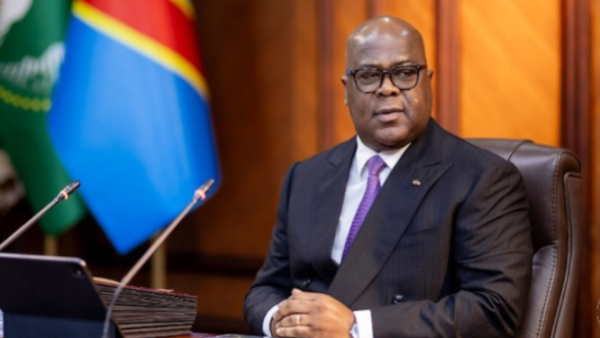
Democratic Republic of Congo President Felix Tshisekedi instructed the government on May 22 to accelerate work on a new national forest policy and produce, within 30 days, an interministerial road map for the management of forest and environmental resources.
The initiative forms part of Kinshasa’s strategy to leverage the country’s vast forest resources to attract more climate financing, strengthen its diplomatic position and reinforce its role in the global energy transition.
The DRC holds around 60% of the Congo Basin rainforest, the world’s second-largest tropical forest after the Amazon. The country also possesses substantial reserves of critical minerals needed for the energy transition. It is the world’s leading cobalt producer, with 220,000 tonnes produced in 2024, representing 76% of global output, and the second-largest copper producer, with nearly 3.5 million tonnes produced in 2025. The country is also a major producer of coltan, with the Rubaya site alone accounting for around 15% of global production.
Those resources place the DRC at the center of global discussions on climate and energy security. Tshisekedi, however, said that position could not gain lasting international credibility without stronger forest governance based on transparency, accountability, respect for local communities and coherent public policies.
Governance challenges remain
Kinshasa has for several years sought to capitalize on its forest resources in discussions with international donors, multilateral institutions and investors specializing in low-carbon projects. In June 2025, the World Bank announced the disbursement of $19.47 million to the DRC under the Forest Carbon Partnership Facility in exchange for reducing 3.89 million tonnes of carbon emissions in Mai-Ndombe province.
That ambition nevertheless faces persistent challenges. International partners regularly cite weaknesses in governance, institutional coordination, legal certainty and transparency in project implementation. The new forest policy is intended to address those concerns through a cross-ministerial road map.
According to the minutes of the Council of Ministers meeting, the road map will cover priorities including forest governance, environmental monitoring systems, community forest concessions and the principle of free, prior and informed consent.
Tshisekedi also wants to integrate the Kivu-Kinshasa Green Corridor project into the new framework. Authorities present the initiative as a strategic program combining forest conservation, local development and green transition objectives.
The president further stressed that environmental governance standards are becoming increasingly important in international financing mechanisms and in the investment criteria used by industrial and financial partners.
Against that backdrop, the government plans to coordinate forest policy with strategic sectors including mining, agriculture, infrastructure, energy, finance and land-use planning. The approach is also intended to attract ESG-focused investment, as environmental, social and governance standards play a growing role in global capital allocation decisions.
Pierre Mukoko & Boaz Kabeya