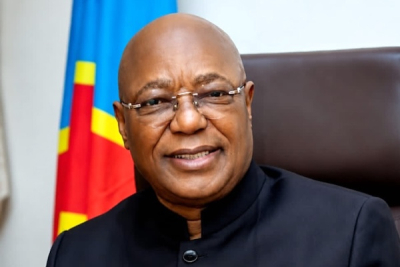





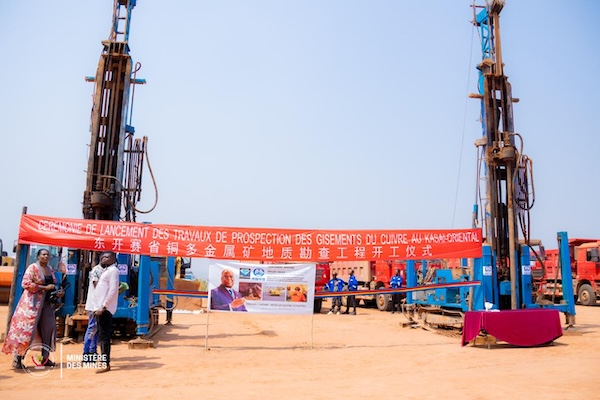
The proposed copper-cobalt complex planned by China Railway Resources Universal (CRRU) and state-owned miner Minière de Bakwanga (MIBA) has advanced to the geological survey stage. Mines Minister Louis Watum Kabamba officially launched prospecting activities in Miabi, Kasai-Oriental province, on June 25.
The campaign marks the start of fieldwork and is expected to provide a clearer assessment of the mineral potential of the targeted areas before any decision is made on commercial mining.
The geological survey comes nearly two months after the project was presented to the government. In early May, a delegation from China Railway Resources Universal outlined plans to the mines minister for an integrated copper-cobalt complex in the territories of Miabi and Kabeya-Kamwanga.
At the time, the proposal described a large-scale mining project with significant planned production capacity and an energy component intended to power future processing facilities. However, several key details remained undisclosed, including resource estimates and ore grades, the exact permit areas, project costs, the implementation timeline and financing arrangements.
Geological Survey to Fill Key Information Gaps
The geological survey is expected to help answer several of those questions. Earlier MIBA documents had already highlighted the lack of reliable geological data on copper-cobalt deposits in the area. Resource estimates and ore grades had not yet been established with sufficient certainty, making exploration a necessary step before any investment decision could be taken.
The work underway in Miabi is expected to generate the data needed to support the next phases of project development, including resource estimates, feasibility studies, mine planning, financing and possible mine construction.
For the government, the initiative forms part of a broader strategy to unlock the country’s mineral potential. Louis Watum Kabamba said that nearly 90% of the Democratic Republic of Congo’s mineral resources remain undiscovered and called for a better understanding of the country’s geology to help guide future investment.
Diversification Opportunity for MIBA
The minister also called on the communities of Miabi and Kabeya-Kamwanga to cooperate with the survey teams. Their participation will be important if the project eventually progresses from exploration to mining.
The project has raised high expectations in the region. Transparency over economic benefits, employment opportunities, environmental impacts and community rights will, therefore, be a key issue as development advances.
MIBA’s participation gives the project added significance. The state-owned company, long associated with diamond mining in the Kasai region, could use the project to diversify into copper and cobalt. However, its exact role in the project’s ownership structure, mineral rights, governance and future economic returns has yet to be clarified.
China Railway Resources Universal also brings industrial expertise and financial capacity to the project. In May, the Chinese group presented plans to develop MIBA’s mining assets through a large-scale copper-cobalt project.
Several questions nevertheless remain unanswered. The ministry has not disclosed the budget or duration of the geological survey, the permits involved, when the results are expected, or the respective responsibilities of the project partners. A third company, LBK Construction SARL, has also emerged as a participant, although its role has not yet been explained.
Boaz Kabeya