





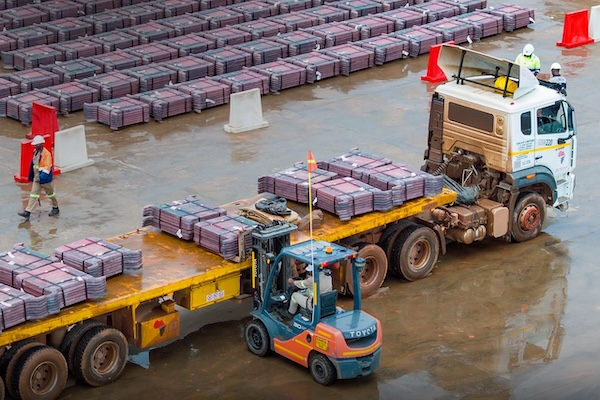
Kamoa-Kakula copper mine in the Democratic Republic of Congo generated revenue of $3.28 billion in 2025, up 5% from $3.11 billion in 2024, according to figures published by operator Ivanhoe Mines on Feb. 18, 2026.
The revenue increase came despite lower production and sales following a seismic event in May 2025. Kamoa-Kakula sold 351,674 tonnes of copper in 2025, down 11.4% from 396,972 tonnes in 2024. Production declined by a similar percentage, falling to 388,841 tonnes from 437,061 tonnes.
Higher copper prices helped offset the decline. The average realized price rose to $4.40 per pound, or roughly $9,700 per tonne, in 2025, compared with $4.09 per pound the previous year, an increase of 7.6%.
On the operational side, Kamoa-Kakula reported EBITDA of $1.45 billion in 2025, representing a margin of 44%, down from $1.81 billion and a 58% margin in 2024.
Profit down
Rising costs weighed on profitability. The cost of sales increased to $2.82 per pound in 2025 from $1.71 per pound in 2024, equivalent to roughly $6,220 per tonne versus $3,770 per tonne. That increase of more than 65% squeezed margins by narrowing the spread between the selling price and production costs.
Net profit after tax fell 56.6% to $439.7 million from $776.9 million, even as the tax charge declined to $317.7 million in 2025 from $345.5 million in 2024.
For 2026, Kamoa-Kakula has set production guidance of up to 420,000 tonnes, unchanged from 2025. Ivanhoe expects sales to rise by around 30,000 tonnes as the mine draws down unsold inventory. Revenue could increase further, with the company anticipating “copper prices close to record levels.”
Ivanhoe Mines and its Chinese partner Zijin Mining each hold a 39.6% stake in Kamoa-Kakula, while the Congolese state owns 20% and Crystal River holds 0.8% through the Kamoa Copper joint venture.
Pierre Mukoko