




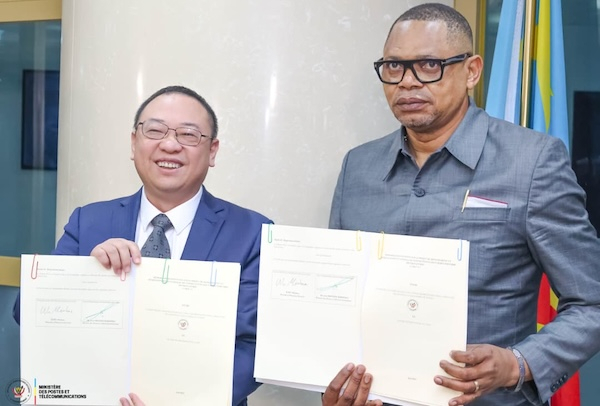
The Democratic Republic of Congo is considering a new approach to expanding its national fiber optic network. On June 25, 2026, the government, through the Ministry of Posts, Telecommunications and Digital Technology, signed a memorandum of understanding with Chinese company Genew Technologies for a fiber optic deployment project along the Congo River.
The proposed project covers about 2,100 kilometers of infrastructure, including 1,700 kilometers of fiber-optic cable running along the Congo River from Muanda to Kisangani and nearly 400 kilometers of terrestrial connections. The objective is to establish major connectivity corridors that would strengthen the country’s future national network.
According to the ministry, the project would use the Congo River and its tributaries as routes for deploying fiber-optic infrastructure. That approach could help avoid some of the challenges associated with overland construction in the DRC, including the country’s vast territory, poor road conditions, logistical difficulties and the need to secure routes.
The project’s total cost is estimated at $1.5 billion, according to Genew Technologies Chief Executive Wu Minhua. More than $400 million would be required for the first phase. The ministry has not yet specified the project’s phases, financing structure, any potential public funding, guarantees, repayment terms or implementation timeline.
An Early-Stage Agreement
That caution is understandable. At this stage, the document is a memorandum of understanding rather than an implementation contract. It sets out a framework for future cooperation but does not establish that financing has been secured or that construction will begin in the near term.
Genew Technologies, which is headquartered in Shenzhen, specializes in telecommunications solutions. Founded in 2005, the company develops network equipment, telecommunications infrastructure and digital solutions for businesses and public sector clients.
Under the memorandum signed with the DRC, Genew Technologies said it intends to provide equipment, deploy the infrastructure, maintain the network and train Congolese technicians. According to the company, the training component is intended to facilitate the project’s implementation and support the network’s long-term operation.
The agreement follows other recent initiatives to expand the country’s national fiber-optic network. A few days earlier, the DRC launched a market consultation ahead of an international tender for the construction and operation of more than 11,500 kilometers of fiber-optic infrastructure, including 1,500 kilometers of international links.
Catching Up
The 11,500-kilometer project is part of the Digital Transformation Project, financed by the World Bank and the French Development Agency. It is intended to strengthen nationwide connectivity, connect more provinces and expand broadband access across the country’s territories.
How the two initiatives will fit together has not yet been clarified. The 1,700-kilometer river corridor could complement the future national network, but its exact scope, financing and legal status remain to be defined.
The ministry said the urgency of these investments reflects the country’s low level of connectivity. According to figures cited in its communication, mobile phone penetration reached 66% in the first quarter of 2026, compared with 0.7% for fixed-line services. Mobile internet penetration was estimated at 30.4%, while overall internet penetration stood at 43%.
Those figures illustrate the scale of the challenge in connecting the country’s 145 territories. In the DRC, limited connectivity continues to slow the digitalization of education, healthcare, public services and economic activity. It also limits the government’s ability to deliver digital public services in rural and remote areas.
Ronsard Luabeya