




The Congolese government plans to test a local certified seed production model in Kasaï-Central, with the aim of gradually expanding it to other agricultural regions across the country.
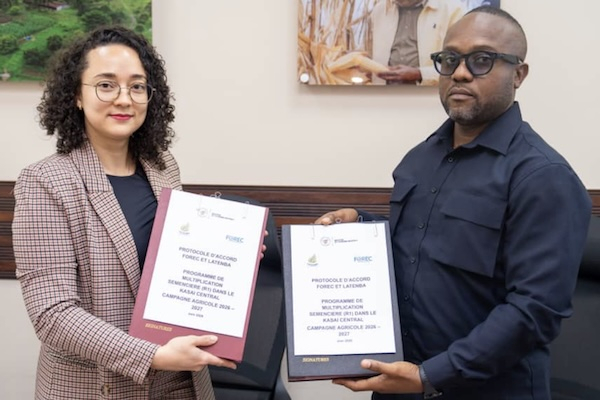
According to a statement from the Ministry of National Economy reported by the Congolese Press Agency, the Economic Regulation Fund (FOREC) launched a pilot program on Monday, June 22, 2026, to strengthen seed production in the central Democratic Republic of Congo province.
As part of the 2026-2027 agricultural season, FOREC signed a memorandum of understanding with LATENBA SARL to implement an R1 seed multiplication project.
According to the ministry, the initiative is intended to test, in real-world conditions, a structured model for supporting local certified seed production, providing technical support to farmers and strengthening agricultural production capacity.
Lessons learned during the pilot phase are expected to guide the gradual rollout of the program in other farming regions, taking into account the agroecological, logistical and economic characteristics of each area.
Food Security
The project is intended in particular to increase the availability of quality seeds, improve farmers' access to essential inputs and help strengthen food security in Kasaï-Central.
The initiative underscores FOREC's expanding role in agricultural value chains. Less than a week earlier, the public institution signed another memorandum of understanding with Société Rizicole de Bumba to support the development of the rice sector in Mongala province.
Through these initiatives, the government aims to use FOREC to help secure supplies of essential goods, stabilize prices and gradually improve food self-sufficiency. At this stage, no details have been disclosed regarding the cost of the program, the acreage involved, the crops targeted or the volumes of seed expected under the pilot phase.
Boaz Kabeya