




Tshopo Governor Paulin Lendongolia Lebabonga traveled to Kinshasa on May 18, 2026, for talks with national authorities over persistent fuel price gaps affecting his province. The discussions focus on differences in the treatment of the eastern and western fuel supply networks serving the Democratic Republic of Congo.
According to the Congolese Press Agency (ACP), the governor is expected to meet Deputy Prime Minister and Economy Minister Daniel Mukoko Samba alongside representatives of oil companies, the Federation of Congo Enterprises (FEC), and provincial experts.
Tshopo has a unique supply structure. The province is supplied both through the western network, mainly via Kinshasa and the Congo River, and through the eastern network, which depends more heavily on regional trade corridors crossing neighboring countries.
Provincial authorities say the two supply systems do not benefit from the same support schemes and compensation arrangements. The governor argues that operators linked to the western network benefit more from certain tax exemptions and state compensation measures than companies supplying the province from the east.
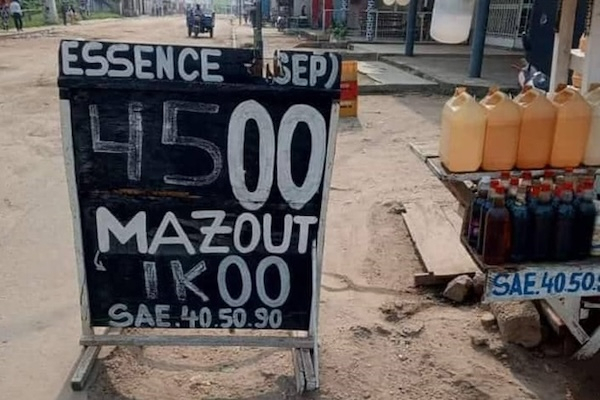
Official prices highlight the disparity. In the western zone, gasoline is priced at 2,640 Congolese francs ($0.93) per liter and diesel at 2,635 francs. In the eastern zone, prices rise to 4,205 francs per liter for gasoline and 5,395 francs for diesel.
The gap complicates efforts to harmonize fuel prices in a province already burdened by high transport and logistics costs linked to its geographic isolation and weak infrastructure.
In Tshopo, where road and river transport are essential for supplying local markets, fuel price increases quickly feed into transport fares, food prices, and household purchasing power. Provincial authorities fear the imbalance could intensify inflationary pressures in the region as the country continues to face recurring tensions over fuel prices.
The dispute also underscores the broader challenge of economic integration in the DRC, where several eastern and northeastern provinces remain more closely connected to regional trade corridors than to supply networks centered on Kinshasa. For these landlocked areas, fuel prices depend not only on national pricing policies, but also on geography, security conditions, and transport constraints affecting each supply route.
Ronsard Luabeya